
Queen Esther saved her people. Michigan’s attorney general just threw them under the bus

Originally published in Washington Examiner

As the summer came to an end, Michigan Attorney General Dana Nessel stood before a room of Jewish Democrats and reached for the Book of Esther. Jews, she intoned, have “a moral imperative to place the needs of the world above even our own self-interest and, yes, even our own survival.” It is, she said, “perhaps up to us now to follow in Esther’s path and sacrifice the comfort, safety, and security and even the very future of our own people in exchange for the opportunity to save the rest of humanity.”

For many decades, I have read the Book of Esther at least twice each year, following along on the holiday of Purim as it is read from a scroll in the original Hebrew. And to say that I do not recognize the story Nessel is telling would be an understatement. It seems far more likely that Nessel went to the Bible in desperation, as she sought to defend the unconscionable as somehow moral.

Esther, needless to say, did not sacrifice her people. On the contrary, the cause for which she risked her own life was their survival. When Mordechai first asked her to approach the king unsummoned, Esther hesitated, because unauthorized entry to the throne room was punishable by death. Mordechai’s admonishment to her is one of the most quoted lines in the entire book: “Who knows whether you have attained royal position for such a time as this?” Her obligation was to save her nation.

That is not a minor detail that Nessel got backward. It is the whole point of the story. Esther used what power she had, at personal risk, in open and unapologetic defense of her people. To invoke her name while asking American Jews to set aside “even our own survival” for someone else’s cause inverts the text entirely.

It also inverts the American ethos, which recognizes life, liberty, and the pursuit of happiness as inalienable human rights, with life first among them. No person should be expected to sacrifice the safety of his or her community for some purportedly noble cause. Given Jewish history, to make such a demand of Jews is particularly vile. One could hardly find a better example of demonizing Jews for being Jews than to cast Jewish concern for our own survival as a failure of virtue. Nessel may be Jewish, but what she said was unquestionably antisemitic.

And if she wishes to “save the rest of humanity,” she should note how previous groups and governments have fared after they acted with hatred toward the Jewish community. No elected official should advocate for America to follow a millennia-long, unmitigated record of disappearance into the dustbin of history. When Esther saved the Jewish people, she also, for a time, saved the empire that had turned against them.

The great sage Hillel taught all humanity a better approach with three simple questions: “If I am not for myself, who will be for me? And if I am only for myself, what am I? And if not now, when?” Note the order. Self-preservation comes first, not as selfishness but as the precondition for everything else a person or a people might contribute to the world. A community with no desire for survival has nothing left to give.

Nessel’s underlying message was stunning: in order to support her party, one must disregard Jewish survival. She claimed that permitting bigotry and hate were prerequisites in order to back her ideology. And while I would argue that, overall, this is certainly not the case, it is most emphatically true regarding several of its candidates, including in her home state. In that regard, at least, the citizens of Michigan would be advised to listen carefully.

Photo: Dana Nessel by Showtime, licensed under CC BY 3.0, via Wikimedia Commons

Charlie Kirk stood with the Jewish People. We must stand for his legacy.

Charlie Kirk

Originally published in Israel National News

One year ago, the voice of Charlie Kirk was silenced by an assassin’s bullet. The Torah teaches, however, that a voice is not silenced when a person leaves the world, as long as others study and learn from his words. The message that Charlie shared cannot be lost with him.

If Charlie stood for one thing, it was values. He advocated for the dignity of every person and group, recognizing the spark of the Divine in every human life. He championed peaceful and robust discourse. He spoke often of the importance of family and children, which he also demonstrated through personal example.

For countless Jews in America and Israel, Charlie was a true friend and ally. At a time when standing with the Jewish people became increasingly difficult and, in some circles, socially and professionally costly, Charlie Kirk stood with us proudly, publicly, and without apology.

Charlie understood what too many influential Americans have forgotten: Israel is not merely a modern country or a political project. It is the ancestral homeland of the Jewish people, promised to Abraham, Isaac, and Jacob, to which Jews have prayed to return for thousands of years.

His support for Israel was not contingent on polling, applause or political convenience, but rooted in moral clarity. Charlie recognized that Israel stands on the front lines of a much larger struggle between civilization and barbarism, freedom and tyranny, life and those who glorify death.

He understood that antisemitism is never only a Jewish problem. Hatred may begin with the Jews, but history teaches us that it never ends with the Jews. A society that tolerates the demonization of Jewish students, the celebration of terrorism or calls for Israel’s destruction is a society surrendering its own moral foundations.

After the horrors of October 7, when Hamas terrorists murdered, tortured and kidnapped innocent men, women and children, Charlie did not equivocate. He did not retreat into comfortable language, much less the moral rot that took over much of American academia. He defended Israel’s right to protect its citizens and confronted the poisonous spread of antisemitism, recognizing these as part and parcel of his efforts to promote peace, justice, and moral virtue.

Charlie recognized the connection between faith, family and freedom. Although he was a committed Christian, he respected the Hebrew Bible, defended the Jewish roots of American civilization, and encouraged young people to reject the emptiness of radical secularism. He called them back to belief, responsibility, marriage, parenthood and service to something greater than themselves.

Along the way, he consistently demonstrated his concern for ideology over identity. In one notable confrontation, Charlie faced the late founder of “Cosmic Judaism,” who rose to promote socialism by dismissing the value of Jewish Day School education and the clear gap between public and private schooling overall. Charlie could not conscience a purported rabbi calling a Torah education “brainwashing,” and rejected the questioner’s claim to accurately speak for Judaism. “No, you absolutely take the Torah literally,” he interjected. “It’s literally the Torah!”

In an age that rewards caution, Charlie was fearless. In a culture drowning in carefully rehearsed talking points, he spoke directly. He specifically entered hostile spaces because he believed truth should never fear a debate.

We must realize, then, that his murder was not simply another senseless crime. It was an attack upon the American tradition of resolving disagreements through argument and persuasion rather than intimidation and bloodshed. This, of course, is one of many key lessons the Founding Fathers learned from our people.

Judaism also teaches us to answer darkness by creating more light. We answer hatred with moral courage, and answer those who attempt to silence truth by speaking it more boldly.

Charlie left behind a wife, children and a movement that continues to carry his mission forward. Our prayers remain with his family, whose loss is beyond measure. May they find comfort in knowing that his life changed millions and that his friendship will not be forgotten by the Jewish people.

May his courage inspire a new generation to stand for values and against antisemitism, to defend life, marriage, Israel, and the freedom to speak the truth. And may we honor him not only with words, but by continuing the work for which he gave his life.

Photo: Charlie Kirk by Gage Skidmore, licensed under CC BY-SA 2.0, via Wikimedia Commons

An endorsement ends any ‘shomer’ myth

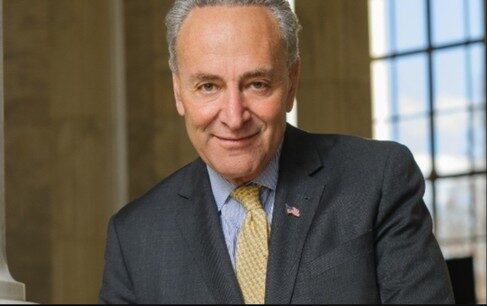
Sen. Chuck Schumer official portrait

Originally published in JNS

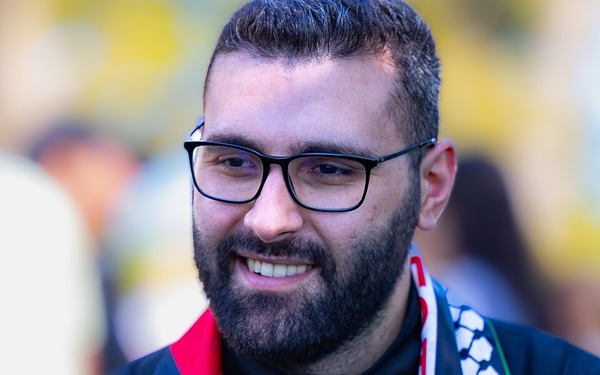
Dr. Abdul El-Sayed’s narrow victory in Michigan’s Democratic Senate primary was a clarifying moment. By endorsing the winner, Senate Minority Leader Chuck Schumer (D-N.Y.) abandoned all pretense of serving as a shomer, or “guardian,” of the beleaguered Jewish community. It is not just that Schumer indicated that he would endorse even an antisemite for political gain; it is that he did.

El-Sayed has not hidden his attitude toward Jews, which wallpapers slogans about Israel and Zionism over classical antisemitism. No one of intelligence could fail to see the similarities between his beliefs and those that overtook Germany less than a century ago.

He regards the Jews as a collective threat, stating without evidence that the Israeli government is “just as evil as Hamas,” the genocidal terrorists responsible for the worst anti-Jewish massacre since the Holocaust. El-Sayed claimed that rescuing hostages from torture and rape, and neutralizing those genocidal terrorists, constitutes “genocide.” Jewish lives, in other words, have no value in his view.

In a modern spin on the old “Chosen People” myth, he accuses Jews of racism, calling the only Middle Eastern country that gives both Jews and Arabs civil rights an “apartheid” state. And like his ideological forebears, he considers a boycott of Jews an appropriate “response.” Perhaps worst of all, El-Sayed used these depraved lies about Israel to justify violence against Jews in his home state. This is no different than the Nazis blaming Jews for the violence of Kristallnacht in 1938.

No one who values Western civilization or basic human decency would consider El-Sayed remotely fit to be a U.S. senator.

This brings us back to Schumer, who is placing political gain ahead of moral principle. During the primary, he backed the more moderate, pro-Israel candidate Rep. Haley Stevens. But once El-Sayed prevailed, Schumer immediately pivoted and was quite forthright about why. He issued a statement with Democratic Senatorial Campaign Committee chair Sen. Kirsten E. Gillibrand (D-N.Y.) that declared they were “united by a common purpose” with El-Sayed: “taking back the Senate.”

To Schumer, party cohesion and electoral math come first, while the character of the nominee takes a distant second. That is why he and Gillibrand both supported the now disgraced Senate candidate Graham Platner in Maine, despite his Nazi tattoo and a series of scandals, until a sexual assault accusation from a former Platner girlfriend sent them scurrying like rats abandoning a sinking ship.

For a lesson in moral courage, Schumer could learn from Boy George, who released a new song, “Od Nirkod” (“We Will Dance Again”), standing with the Jewish community at great professional and personal cost. In fact, he could study a political leader Schumer himself has accused of antisemitism in the past: U.S. President Donald Trump.

Trump has openly stated that El-Sayed hates Jews and Israel. Though entirely accurate, one could dismiss this as political posturing based upon party affiliation. This, however, would fail to recognize Trump’s penchant for repeatedly getting it right about hatred of Jews and Israel. He demonstrates this most clearly not when his targets are his political adversaries or adversarial college administrators, but his fellow Republicans.

Trump has distanced himself even from former allies over antisemitism, pushing back when they cross into anti-Jewish bias and conspiracy theories. He forcefully rejected former Georgia Rep. Marjorie Taylor Greene and actively campaigned against soon-to-be-former Rep. Thomas Massie (R-Ky.), both Republicans.

After podcaster Tucker Carlson’s interviews with a series of antisemitic bigots and his subsequent attacks on Trump’s policy on Israel and Iran, including claims that attacked Jewish organizations, Trump declared that Carlson “has lost his way,” is “not MAGA” and does not represent “America First.” Trump has said his movement has no room for antisemites.

This difference in attitude has an obvious practical impact upon the two parties. The most powerful Democratic leaders, including one who proudly trots out his personal Jewish identity whenever it suits him, treat fighting antisemitism and the demonization of the Jewish state as secondary to gaining power.

Leaders on the other side, including Trump, Senate Majority Leader John Thune (R-S.D.) and House Speaker Mike Johnson (R-La.), dismiss erstwhile allies and refuse to include them and their bigoted views for political profit.

This is what Jews in America need: not calculations of which candidate is electable in a purple state, but clarity on who will defend their security and legitimacy without apology.

El-Sayed’s primary victory, coupled with Schumer’s subsequent endorsement, demands a moral choice that transcends political inclinations. True friendship with the Jewish community is evaluated based on actions and adherence to principles, rather than on birth certificates or party affiliations. In this regard, the Democrats’ record is not even close to that of the Republicans.

Photo: Chuck Schumer official photo by U.S. Senate Photographic Studio/Jeff McEvoy, public domain (U.S. federal government work), via Wikimedia Commons

Mamdani’s anti-Israel madness all hinges on the ‘Palestine’ lie

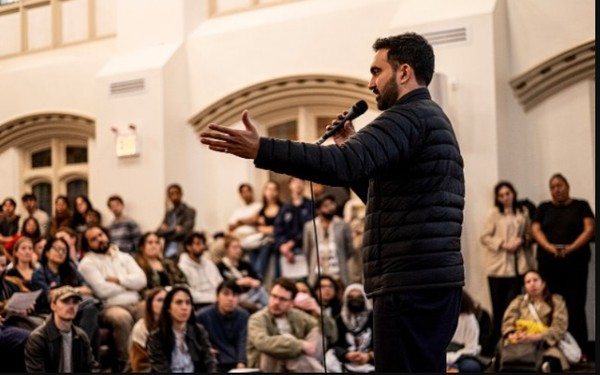
Zohran Mamdani speaking at a DSA 101 meeting in New York City

Originally published in Washington Examiner

NYC Mayor Zohran Mamdani’s bogus threat against Israel’s prime minister revealed something essential about his political career — and even more about his sycophants. When Mamdani promised to arrest Benjamin Netanyahu should he set foot in the United States, only to admit that this would be both impossible and illegal just days later, his fan club did not blink, much less assess whether he was prone to reckless, false claims. They simply moved on.

That indifferent reaction is the point: Mamdani’s followers are not impressed by truth or history.

A fact-free mob is dangerous, often more likely to justify violence than to condemn it. One can expect that they will respond to his new call for “protest” by conducting themselves like those described on CNN as “mostly peaceful” while stores burned in the background. As NYPD Police Benevolent Association President Patrick Hendry put it, “violent agitators will assume they have permission to cause as much havoc as possible.” Already, a deranged man yelling Allahu Akbar attacked bystanders (including a Jew coming from prayers) in NYC just days after Mamdani’s racist tirade.

And Mamdani must have known he was inciting his crowd. He gave them not only permission but pretense, stating as fact that Netanyahu was a “war criminal,” deserving of a violent welcome. He claimed that Israel’s rescue of hostages being tortured, starved and raped, and the elimination of the terrorists responsible, constituted a “genocide.”

He wants us to imagine that it’s simply coincidence that the victims whose rescue he condemned were primarily Jews. Surely he would deny being the monster and sexual deviant that such condemnation makes him out to be.

But, crucially, his entire effort is based upon such obvious lies. Equating the neutralization of terrorists to murder of civilians is the least of his problems.

That honor goes to the underlying narrative of “Palestine,” which Mamdani and his followers defend with fervor and without curiosity.

The Bible refers to Israel thousands of times as both a nation and a homeland. “Palestine,” on the other hand, was invented by Greco-Roman colonialists, and instituted by Hadrian to replace the indigenous name Judea, identified with the Jews he was driving out.

The “Palestinian” flag flown at rallies is derived from that of the Arab Revolt of 1916, representing no new identity, but the Jihadists’ dream of a unified Arab kingdom from Syria to Yemen. Old administrative maps of the British Mandate, and similar bureaucratic charts dating back hundreds of years, are exploited to rewrite the historical record of the land they depict.

The history of the region called Palestine is real — and overwhelmingly Jewish. It produced the Palestinian Talmud (also called the Jerusalem Talmud) and the Palestinian Gaonate.

The four central cities of Jewish scholarship — Jerusalem, Hebron, Safed, and Tiberias — fundraised together for centuries as “the Four Holy Cities of Palestine.” Maimonides, Rabbi Yosef Karo, the Ari, and Rabbi Moshe Cordovero all lived and taught there. Safed alone produced a revolution in Jewish mysticism.

None of the foregoing related to “Palestine” as anything more than the name used by Greco-Roman and Christian scholars. And notably, there is no parallel Arab or Muslim, much less “Palestinian,” intellectual tradition tied to the region, until Arafat’s PLO determined that manufacturing one would serve their bigoted cause.

In other words, the modern Palestinian national narrative is a mid-20th-century political fiction, built upon the erasure of two millennia of Jewish history and the denial of the land’s holy status to Jews as their homeland and center of Jewish religious practice. That is not a judgment about any individual Arab or Muslim, much less “Islamophobia.” It is simply historical fact.

Thus it is fair and accurate to describe Mamdani’s followers as indifferent to the truth. The tragedy is not that Mamdani is so wrong, so malevolent, and so clearly adversarial towards American values, but that his followers have lost the ability to care.

That is why his reelection isn’t just plausible, but likely — at least until New Yorkers recognize that following in the historical footsteps of Berlin and Moscow is a truly bad idea.

Photo: Zohran Mamdani Speaking at a DSA 101 Meeting at the Church of the Village in NYC by Bingjiefu He, licensed under CC BY-SA 4.0, via Wikimedia Commons

CUFI reminds us that the Jewish People are not alone

Originally published in Israel National News

There are moments when you leave a gathering feeling not simply encouraged, but genuinely inspired. Less than three years after the greatest massacre of Jews since the Holocaust, and amid a worldwide resurgence of antisemitism, attending Christians United for Israel’s annual conference was one of those moments. This is not simply because CUFI is home to millions of admirers and supporters of the beleaguered Jewish community, but because of the courage found among them.

When antisemitism is surging around the globe, Jewish students are harassed on college campuses, and synagogues require heightened security, the easy course is to keep one’s distance. Some would even call that prudent. CUFI celebrates those who do just the opposite, who lean in against those who threaten us. CUFI’s founder and creator, Pastor John Hagee, put it this way: “If a line has to be drawn, draw it around Christians and Jews. We are united.”

Since launching “A Night to Honor Israel” in 1981, Hagee has built what has become one of the strongest and most consequential pro-Israel movements in America. Millions of faithful Christians have chosen not merely to express sympathy for Israel or the Jewish people, but to stand with us publicly, consistently, and unapologetically.

Walking through the conference halls, I met pastors, students, community leaders, military veterans, and families from across America. They were motivated not by politics, but by deeply held moral conviction. They spoke about Israel as America’s democratic ally, and the shared Biblical values that have shaped Western civilization. They spoke about religious liberty, human dignity, and the ties between Christians and the Jewish People.

Standing with Israel is no simple matter, especially for young students; it can invite criticism, targeted vandalism, and social ostracism. The conference featured panelists from CUFI High School and CUFI on Campus, who offered personal accounts of the consequences they faced for standing with Israel and against antisemitism.

Pastor Russell Johnson leads a church in what he described as “the People’s Republic of Seattle.” When he decided to hold a “Night to Honor Israel” with CUFI, he said, they “had protesters in the service, in the parking lot, and all around the building.” But it was more than worth it, he said, to host Pastor Hagee, whom he called “a hero of mine,” and to stand with “the most free, prosperous, and equitable ally that America has ever had in the Middle East.”

In an age where many are eager to lecture Jews about what our security should look like or how Israel should defend itself, these men and women came simply to stand with us. They understood that after October 7 and its aftermath, solidarity is not merely symbolic. Rivkie Feiner, an Orthodox Jewish woman attending CUFI the first time, said that she “was very impressed at how unabashedly loud and proud they are in their support of Israel and the Jewish community” – and that she wished all Jews would display the same confidence and commitment.

The Torah teaches the importance of hakaras hatov, the obligation to recognize and acknowledge those who do good for us. We cannot take such friendship for granted.

Throughout our history, there have been moments when others remained silent in the face of antisemitism. And for nearly two millennia, organized Christian support for the Jewish people on this scale would have been unimaginable. Whatever our theological differences, this partnership represents one of the most remarkable developments in modern Jewish-Christian relations; millions of Christian Zionists are choosing courage, and we should thank them for their support and their bravery.

That does not erase the deep theological differences between our faiths, nor should it. We remain distinct religious communities with different beliefs and traditions. But friendship does not require uniformity, and mutual respect does not require agreement.

In fact, Pastor Hagee proudly recounts how the “Night to Honor Israel” might not have gotten off the ground, were it not for the early and vocal support from a local Orthodox rabbi, who recognized his sincerity and became a close colleague and friend. There was only one Orthodox synagogue in San Antonio, Texas, in 1981: Congregation Rodfei Shalom, led by Rabbi Aryeh Scheinberg, ob”m. When Hagee encountered suspicion from officers of the local Jewish Federation, it was Rabbi Scheinberg who posed a simple question: “but what if he’s a good person?”

That CUFI is represented by good people was evident throughout the conference. They view the rise of antisemitism as not merely a Jewish problem, but a warning sign for society itself. They know that hatred directed toward Jews never remains confined to Jews, but is the first symptom of a deeper moral sickness that eventually threatens everyone’s freedom.

That understanding should give us confidence. It means millions of Americans recognize that supporting Israel is about more than foreign policy. It is about defending the principles of liberty, religious freedom, and democracy that benefit all people.

America itself has long been blessed by this partnership between faithful Jews and Christians. Together, we have defended religious liberty, strengthened families, supported charitable institutions, fought poverty, opposed totalitarian ideologies, and advanced the timeless belief that every human being is created in the image of God.

Those shared values are worth preserving.

The enemies of Israel are loud. The antisemites dominate too many headlines. Social media often magnifies the ugliest voices in our society.

But they do not speak for America.

In a media environment that often amplifies division, outrage, and conflict, gatherings like the CUFI conference remind us that another story is unfolding across America. It is the story of millions of decent people who reject hatred, reject antisemitism, reject terrorism, and refuse to abandon Israel. And it is the story of those who look past our differences to unite behind common goals for America, Israel, and the world.

That story deserves to be told.

The Jewish people know that our ultimate security rests in the protection of the Almighty. But we are also compelled to show hakaras hatov-to recognize and thank those through whom He blesses us. To CUFI, and to those of every faith and none who stand for Israel when it is costly, who speak plainly where others hedge, and who keep the moral line between those who defend life and those who glorify hatred, thank you.

Your friendship is seen, your support is felt, and your advocacy makes a difference. Because of friends like you, the Jewish people know that we are not alone.

In Court Filings, FACE Act Defendants Plead Antisemitism

Originally published in JNS

In the federal FACE Act case born from the mob that blocked access in November 2024 to a synagogue in West Orange, N.J., the defendants are asking the courts to abandon the constitutional protections of religious freedom that make America great, while disregarding Jewish law, prayer and lived experience. One could hardly seek better proof that the defendants in this instance discarded both the law and America’s founding principles in their pursuit of antisemitic bigotry.

The legislation was initially designed to protect people entering abortion clinics from being harassed; eventually, it was expanded to apply to the entrances to houses of worship.

The Party for Socialism and Liberation New Jersey, American Muslims for Palestine New Jersey and numerous individual defendants all outrageously insist that the synagogue event they disrupted—one that memorialized a murdered Israeli rabbi and encouraged Jewish life in Israel—was not religious at all. They arrogate for themselves the right to decide what Judaism is, what Jews believe and which parts of Jewish life count as religious. That is not a legal defense, but an act of erasure, as antisemitic as it is unconstitutional.

The court filings could hardly make their intent and animus more blatant. One defendant asserts therein that encouraging Jews to live in the Holy Land “could not plausibly be interpreted” as a religious activity. Another compares such a real estate fair to “bingo night in a church basement.” A third faults the government for failing to prove, from Jewish law, that it’s a mitzvah (“commandment”) for Jews to live in the land of Israel, as if U.S. attorneys should be expected to research Jewish sources to establish basic Jewish tenets.

All of these attempt to force the courts into unconstitutional entanglement with religious doctrine, while denying and distorting obvious Jewish beliefs.

The First Amendment, to be certain, forbids the courts from wading into this argument; they cannot be called upon to determine what is or is not a Jewish religious activity. American courts cannot claim expertise in the Jewish attachment to the Land of Israel, the relevant mitzvot (“biblical commandments”) or how they apply today.

At the same time, the defendants’ attitude is so obviously at odds with Jewish belief and so dismissive of the Jewish experience as to prove antisemitic bias. The desire to live on holy ground is a theme that saturates Jewish prayer, holy texts and halachah (“Jewish law”). Antisemitism does not only target Jews as individuals, but Judaism as a religion, and the defense filings openly express that the defendants share this familiar and repugnant hostility.

To claim that a synagogue event about land in Israel is “not religious” requires, first of all, that one deny the mitzvah of yishuv ha’aretz, “settling the land,” affirmed by the Ramban and rooted in Torah. It demands nullification of the pleas for rebuilding of Jerusalem and the Holy Temple, restoration of the Davidic Kingdom and return of the Divine Presence that are at the core of every Jewish prayer service, every day of the year.

And, of course, it erases religious expression by Jews. Whether those making aliyah come from the United States, France, Ethiopia, Ukraine, Argentina or anywhere else, political Zionism is rarely even a secondary concern. The overwhelming majority move either to escape Jew-hatred or to fulfill numerous religious commandments, including living in the Land of Israel and participating in its rebuilding. Maimonides, Rav Ovadiah of Bartenura, Rav Yosef Karo, in addition to the hundreds of students of the Vilna Gaon and Ba’al Shem Tov who moved to the Land of Israel, all did so exclusively as an expression of their Jewish religious beliefs.

Most fundamentally, to insist that their motivations are “not religious” is to tell the Jews targeted at Congregation Ohr Torah that their own lives, fears, hopes, beliefs and commitments do not matter. That is not a defense. It is an expression of transparent—and transparently hateful—disregard for Jewish humanity.

The FACE Act protects all forms of religious exercise, not only ritual. Congress enacted it to protect houses of worship and religious communities from intimidation and obstruction. This protection is not limited to prayer services, but encompasses the full spectrum of religious life, including gatherings that express, celebrate or advance a community’s religious identity. A synagogue event discussing Jewish life in Israel is unquestionably part of that spectrum.

If a court accepted the defendants’ framing, that would set a chilling precedent. Jewish prayer would be protected, but attempts to realize the commitments expressed in those prayers would not. That would hamper Jewish religious liberty no less than attacks on circumcision or kosher meat. It would have the courts annul the parts of Judaism that anti?Israel activists find inconvenient.

The defendants’ argument is unconstitutional because it asks the court to define Judaism, and antisemitic because it expressly denies both Judaism’s own self?definition and the religious beliefs of the targeted Jews. In other words, the defendants want the courts to declare their activities not to be hateful or bigoted, precisely because they are.

This is dangerous not only for Jews who seek to fulfill mitzvot, but for all Americans who share the reverence of the country’s Founding Fathers for religious freedom and tolerance.

Consider that without those principles, Pilgrims in Massachusetts, Mennonites in Pennsylvania and Anglicans in Virginia could not have united to build the world’s dominant superpower. The defendants have thus proven both their guilt and their hostility towards Judaism, Jewish life and the values that make America great.

Tucker Carlson takes on the Bible

Originally published in All Israel News

By the time Tucker Carlson trashed the Book of Esther, describing the source of the Jewish festival of Purim, it was already Passover. But timing was the least of his errors, and since he took it upon himself to rewrite Scripture and misinform the masses, those who revere the Holy Bible must now take a stand for God and his Word.

Carlson told his listeners that the Book of Esther was “controversial,” that the Book describes: A Genocide of Persians. Oh yeah, 75,000 Persians… Not just people who committed crimes but people who were Persian, and that’s why they were killed.

I would suggest that such a grievous misreading requires not only a “low IQ,” as President Trump recently put it, but a mind burdened by hate. Call it “Jew Derangement Syndrome.” And far from being an affliction limited to Carlson and a few others, this particular mental illness afflicts the multitudes claiming Israel committed a “genocide” in Gaza, rather than Persia. And that is why it is so crucial that those who wish to learn from the Bible, rather than rewrite it to serve their own bigoted interests, emphatically correct the record.

The account in the Book of Esther is quite the opposite of Carlson’s. There was indeed a planned genocide, but of the Jews, architected by the evil Haman. When Queen Esther intervened, disclosing that she was a Jew herself, King Ahasuerus was bound by Persian law that his decrees not be rescinded. Instead he issued a second one, permitting the Jews to defend themselves.

The fighting that followed, per the Biblical text, was not an offensive campaign, but self-defense against a genocidal mob.

Perhaps Carlson’s greatest offense was to claim that the mob was targeted because they were Persian. “That’s why they were killed,” he said. Scripture could not be more clear; those killed were “of those who hated them,” says Esther 9:16. They came from all 127 nationalities of the empire; their unifying characteristic was murderous hatred for Jews.

The obvious motivation for this inversion, misportraying a genocidal band of antisemites as innocent victims of Jewish bigotry, is that Carlson shares their same hate. Allowing Jews to defend themselves is what he terms “genocide.” By telling a lie so obvious, Carlson exposed a broader pattern which is as evident regarding Israel the modern country as Israel the ancient people.

The side responding to violence is recast as the initiator, while the culpability and hateful motivations of those that launched the attack is ignored. Context is ignored, in favor of an immoral calculus in which the side with the lower casualty count is presumed to be the villain.

This is just as obvious in media reports relying upon the Hamas-controlled Gaza Health Ministry as it is in Carlson’s dystopian version of Esther. This type of inversion is found not only in the charge of genocide, but also in the details. For example, it is a criminal violation of the laws of warfare to store weapons in a school, or to use a hospital as a military base. Once this crime has been committed, the former school or hospital becomes a legitimate military target as a result. Yet Hamas knew that it could commit war crimes with impunity, because global media outlets would falsely report that Israel bombed a school or hospital, rather than the Hamas base that they had become.

To offer a specific illustration, when Israel bombed the Hamas Command and Control center located in the Nasser Hospital building in Khan Younis, outlets from the BBC to NPR to CNN reported the “outrage” that Israel bombed a “hospital” and “killed journalists, health workers and emergency response crews.” It failed to mention that the erstwhile hospital was a base for Hamas fighters that had been used to imprison hostages.

This sort of omission of relevant context happened far too often to be brushed away as an innocent error. In a just and decent world, CNN executives would have faced federal charges under the Antiterrorism Act for having provided material support to Hamas.

Such lies have a real human cost: Hamas puts journalists, doctors, and children at risk knowing both that Israel will risk her own soldiers’ lives to take more efforts to avoid harming them than would any other military force, and that despite this, when civilians are inevitably harmed, Israel rather than Hamas will be blamed. Gazan children died in the conflict because Hamas knew it could rely upon CNN to cover for its crimes.

Antisemitism does not merely harm Jews.

The Book of Esther is deliberately structured to highlight the reversal of fortune—the oppressed rising up against their would?be oppressors. But the story is also careful to preserve the moral logic of that reversal. The Jews defend themselves; they do not plunder, nor do they initiate violence. The text is a celebration of survival, not slaughter. And that is the account found in the most published Book on earth.

Esther, and Carlson’s distortion thereof, tells us how dangerous misinformation can be, especially when motivated by hate.

Newscasters can reverse victims and villains. Pundits can invert the moral order of a story. And podcasters can mislead us into condemning those who are simply fighting for their survival.

In an age saturated with data but starved for context, the ancient text offers both modern lessons, and an obligation to stand up in its defense.

Tucker Carlson did us a favor

Originally published in Israel National News

When Tucker Carlson described the Book of Esther as celebrating a “genocide of Persians,” he did the world a favor. Not because his perspective was correct or well-informed, but just the opposite. His obvious lie, so clearly detached from reality, unwittingly revealed the true nature of the more contemporary charges of genocide leveled at the same People of Israel.

The Book of Esther offers no possibility for error regarding who was responsible for the violence. It tells us that Haman convinced the Persian king, whose empire stretched to the very limits of the civilized world, to issue a decree seeking annihilation of the Jews. When Queen Esther intervened, disclosing that she was a Jew herself, the king was bound by Persian law that his decrees not be rescinded. Instead he issued a second one, permitting the Jews to defend themselves. The fighting that followed, per the Biblical text, was not an offensive campaign, but self-defense against a genocidal mob.

The text emphasizes this in the same verse that tells us that 75,000 were killed (Esther 9:16). It tells us that, contrary to Carlson’s delusional retelling, the dead were neither Persians nor members of any one nation or faith. Instead, the casualties are described as “from those who hated them.” Their one unifying characteristic was that they had come out to kill Jews.

Yet in Carlson’s twisted version, all of this context was erased. The initiating threat vanished. The murderous mob disappeared. All that remained was a single statistic reframed as evidence of Jewish aggression, self-defense recast as “genocide.” Carlson only found the Book of Esther “controversial” after he had deprived the sacred text of both meaning and value.

This was no innocent misreading of the Bible. On the contrary, it exposed a broader pattern which is as evident regarding Israel the modern country as Israel the ancient people. The side responding to violence is recast as the initiator, while the culpability of those that launched the attack is ignored. The mechanism is simple: remove chronology, agency, and intent. Reduce everything to a single, emotionally charged statistic, and then use that casualty figure to invert reality.

And that brings us to the recent conflict in Gaza.

Here, too, numbers were presented without the events that produced them. The initiating attack was omitted, along with the stated intent of the attacking party. The distinction between targeting civilians and combatants was blurred or erased. And what remained was a false narrative in which the party responding to violence was portrayed as the aggressor, while the party that initiated the violence was treated as a passive backdrop.

To be clear, the parallel is not between Esther and Gaza as historical events, but between the use of the same rhetorical mechanism to distort them. In both cases, context is erased in favor of an immoral calculus in which the side with the lower casualty count is presumed to be the villain. Numbers alone determine guilt, while history is deemed irrelevant.

Reality, of course, does not work that way, but all too many political and media figures routinely partner with Haman’s ideological descendants to demonize Jews.

It is a criminal violation of the laws of warfare to store weapons in a school, or to use a hospital as a military base. Moreover, once this crime has been committed, the former school or hospital becomes a legitimate military target as a result. Yet Hamas knew that it could commit such crimes with impunity, because global media outlets would falsely report that Israel bombed a school or hospital, rather than the Hamas base that they had become.

To take a specific example, when Israel bombed the Hamas Command and Control center located in the Nasser Hospital building in Khan Younis, CNN reported upon the “outrage” that Israel bombed a hospital and “killed journalists, health workers and emergency response crews.” It failed to mention that the erstwhile hospital was a base for Hamas fighters that had been used to imprison hostages.

This sort of omission of relevant context happened far too often to be brushed away as an innocent error. In a just and decent world, CNN executives would have faced federal charges under the Antiterrorism Act for having provided material support to Hamas.

Such lies have a real human cost: Hamas puts journalists, doctors, and children at risk knowing both that Israel will risk her own soldiers’ lives to take more efforts to avoid harming them than would any other military force, and that despite this, when civilians are inevitably harmed, Israel rather than Hamas will be blamed. Gazan children died in the conflict because Hamas knew it could rely upon CNN to cover for its crimes.

Antisemitism does not merely harm Jews.

The Book of Esther is deliberately structured to highlight the reversal of fortune-the oppressed rising up against their would?be oppressors. But the story is also careful to preserve the moral logic of that reversal. The Jews defend themselves; they do not plunder, nor do they initiate violence. The text is a celebration of survival, not slaughter.

When Carlson stripped away that context, he was not offering a “new interpretation” but a grotesque distortion. He took a story of self?defense and deliverance and turned it into a false tale of aggression.

The lesson of Esther, and Carlson’s distortion thereof, is not that numbers are irrelevant, but that numbers without context are dangerous. They can reverse victims and villains. They can invert the moral order of a story. And they can mislead us into condemning those who are simply fighting for their survival.

In an age saturated with data but starved for context, the ancient text offers practical lessons as applicable today as at any time in the past.

Image Credit: Book of Esther by Anita Gould with CC BY-NC 2.0 license on Flickr

There’s No Academic Freedom to Incite Hatred

Originally published in The Daily Signal

As both President of Princeton University and the immediate past Chair of the Association of American Universities Board of Directors, Chris Eisgruber has a powerful voice in the academic world. And at least thus far, Princeton has been only a minor target of government investigations of antisemitism.

This has positioned Eisgruber to lead the pushback from university administrators and faculty against demands from the Trump Administration and Congress that they do more to combat Jew-hatred if they wish further federal funding. And he is guiding America’s most elite educational institutions along a predictable path to failure.

Princeton historically prided itself on excellence, and shaped my understanding of political movements, public policy, and technology in ways that influence my work every day.

This is why I find Eisgruber’s monotonous drumbeat of cries for “academic freedom” so disappointing.

Academic freedom is valuable when it enables pursuit of truth, not as cover for bigotry. The ability to spout hate does not obligate the American taxpayer to support it. Stripped of high-sounding verbiage, Eisgruber is advocating for the “right” of antisemites to inculcate hatred in America’s future leaders, free from the pesky burdens of America’s civil rights laws.

Title VI of the Civil Rights Act prohibits an institution receiving federal funding from discriminating on the basis of race, color, or national origin.

The Trump Administration clarified that Jews do not lose this protection for also sharing religious practices. A university that supports denying the Jewish people their right to self-determination, characterizing Zionism as a racist endeavor, or otherwise judging Israel by arbitrary standards applied nowhere else, is rightly ineligible for government funding.

It is that simple.

History provides a sobering precedent.

Germany stood at the pinnacle of academia for nearly two centuries. But then, even before but especially after the First World War, ancient and pernicious hatred rebranded itself as a meritorious academic discipline: “Anti-Semitism.” This gave Hitler’s genocidal evil an intellectual veneer; half of the architects of his Final Solution held doctorates from Germany’s, and the world’s, finest schools.

When the Nazis purged Jews from government positions and universities in 1933, they cast prejudice as beneficial, calling their edict the “Law for the Restoration of the Professional Civil Service.”

The truth was precisely the opposite: the brain drain of scholars like Albert Einstein, Max Born, and Lise Meitner permanently ended Germany’s status as the global leader in scientific research. German universities ruined their own reputation by prioritizing bigotry over scholarship.

The parallel is obvious.

Today America’s elite universities demand “academic freedom” to teach “Anti-Zionism” instead. And the brain drain is already happening, on Eisgruber’s watch and under his nose.

When Princeton joins other leading schools putting antisemitic mythology on the curriculum, giving tenure to hateful professors, and supporting student organizations that back Hamas terrorism against Jews, Jewish students rightly choose to go elsewhere.

American academia suffers the consequences.

Today we are seeing hesitation in the face of harassment, equivocation where there should be enforcement. Formerly elite universities, in and beyond the Ivy League, now substitute antisemitic indoctrination for anthropology, archaeology, history, religion, sociology, and a host of other academic disciplines.

To claim that this comports with the reputed priorities of the Ivy League is laughable.

If academic freedom means tolerance for anti-Jewish discrimination, its schools will follow Germany’s in reputation and authority. Yet learned professors obfuscate, blaming government control rather than hatred for Germany’s lost academic prowess.

They have it backwards.

The Nazis put university-grown hatred into practice; President Trump and Congress are fighting to save American academia from that same bigotry. Their demands are as simple as they are morally proper: enforce Title VI. Protect Jewish students as they would any other group. Draw the line between free expression and harassment. And ensure compliance with the law that is a core prerequisite of federal funding.

As an alumnus, I am not condemning the university, but “speaking up,” in the words of its recent campaign, for what it is supposed to represent. The Ivy League should be leading the way in upholding civil rights, rather than fighting against what is both necessary and right.

Princeton University Graduate College by Zeete, via Wikimedia Commons with CC BY-SA 4.0

Western Wall debate must not overshadow prayer, unity during times of war

Originally published in the Jerusalem Post

By Rabbi Yaakov Menken and Rabbi Jonathan Guttentag

As we prepared this piece for submission, Israelis were repeatedly forced to seek shelter, while gunmen attacked Jews in both Israel and the United States. We pray for all of our safety.

We also find it particularly distressing to discuss attacks upon the layout and usage of the Western Wall prayer area, which was recently closed due to missile threats, at this time. Yet even with Israel at war, American Reform leaders and allies are delivering speeches and interviews warning of “radicals” in Israel who wish to uphold traditional practice at the Western Wall. At a moment when Israel faces immediate and existential danger, this is more than a needless distraction.

Efforts to alter the character of the Kotel rest upon the false premise that there are millions of Jews, primarily in the Diaspora, whose support for Israel will wane if longstanding Jewish tradition is not abandoned. But portraying sincere Jewish religious expression as hostile to Israel’s future perfectly inverts reality. Right now, we need more prayer, not challenges to Jewish tradition outlining how prayer is appropriately done.

The Western Wall is not a civic square or public park. It is the last accessible remnant of the Beit HaMikdash (Holy Temple) and the spiritual center of Jewish memory for nearly two millennia. Ever since Israel gained control of the site in 1967, restoring religious freedom to Jews and all others, prayer arrangements at the wall have been conducted according to halachic (Jewish legal) practice.

How this came to be, and why there is a dignified and welcoming plaza there at all, is no mystery. Construction was not driven by political horse trading in the Knesset, nor was the plaza the brainchild of a functionary in the Religious Services Ministry. People voted with their feet, coming to pray there every day, rain or shine, throughout the year – and the space was built to serve them.

No matter how meaningful other uses may be, the primary purpose of the Western Wall site is not to be an archaeological garden or a place to swear in new IDF soldiers, but to be a sanctuary for heartfelt prayer and devotion.

This framework has been maintained by Israeli governments of the Left, the Center, and the Right. And thus, the Knesset initiatives under discussion do not introduce a new religious order at the wall. Neither do they submit the plaza to extreme or arbitrary standards, as Reform leaders claim. And to portray them as a plan to imprison Jews for prayer, as some have done, is simply beyond the pale of rational discourse. To the contrary, the proposed legislation responds to threats by progressive activists against the very things that make the Western Wall plaza appealing to those anxious to pray there.

It is hardly a secret that Women of the Wall and its American financiers never intended to add to the sanctity of the place. Its leaders openly declared their intent to disrupt the prayers of others, and they bring “a folding table and a megaphone,” not to mention a media entourage, to their every “service.” There is no natural, organic support for their operation; it is not spiritual, but political.

The claim that “millions” are being disenfranchised is thus one that obfuscates rather than clarifies. Jewish life today is extraordinarily diverse, and no movement can credibly claim to speak for the entire Jewish people. But there are no millions occupying seats in today’s Reform and Conservative congregations even on the High Holy Days, much less on a daily or weekly basis. And it is obvious that Jews who rarely engage in Jewish prayer in their hometowns are not deeply troubled by how prayers are conducted by Jews in Israel.

Furthermore, the current division of the Western Wall is nearly sixty years old, and was preceded by another eighteen years during which no Jew was permitted to pray there. Given that most living Jews never experienced anything different, it is specious at best to assert that prayer practices at the wall might explain why younger Jews are joining anti-Israel rallies. Most of them have never set foot in Israel, and could not point to the Western Wall on a map.

There is, of course, one segment of the Jewish community that has only increased its attachment to Israel, and this is reflected in the current composition of the World Zionist Congress, despite entire segments of the Orthodox and Hasidic communities who would not vote in its elections, yet pray at the Western Wall frequently.

For many years, Reform and Conservative leaders, in alliance with left-wing Israeli parties, exercised dominant influence within Zionist institutions. Today, this has been reversed, despite deliberate attempts to minimize the Orthodox vote. Israel would be ill-advised to take steps that only offend the sensibilities and religious precepts of its most ardent supporters.

A site of unmatched holiness should not be subject to political maneuvering, especially at a time when prayers are so clearly needed. The administration of the Western Wall should remain responsive to public demand. This is determined by foot traffic, not PR statements. And the consistent, ongoing disuse of the Ezrat Yisrael section, the “Egalitarian Kotel” created by then-Religious Affairs minister Naftali Bennett in 2013, offers silent testimony (pun intended) to the utter lack of interest in change.

The Kotel carries profound meaning for Jews of every background. That shared attachment should encourage thoughtful and honest debate. Instead, increasingly dramatic claims portray policy disagreements as existential threats and preservation of halachic norms as religious persecution.

The Jewish people have always been capable of serious disagreement about sacred space. But those disagreements should be conducted with accuracy, proportion, and respect for the democratic and institutional frameworks through which decisions about Israel’s most sacred national sites are made – especially at a moment when Israel faces grave external threats, and the Jewish world seeks unity and clarity.

Cover Image: View of an Ancient City by Leon Natan, Accessed via Pexels with CC0 Deed

Pin It on Pinterest

Share This